
Piers & house leveling
Push and helical piers, and how depth to limestone varies.
A new depression in the yard, a drain that suddenly swallows water or cracks near a sinkhole call for a careful, step-by-step approach. We connect Bowling Green-area homeowners with independent local foundation repair companies for free, no-obligation quotes.
Get a Free Quote Call (727) 300-6656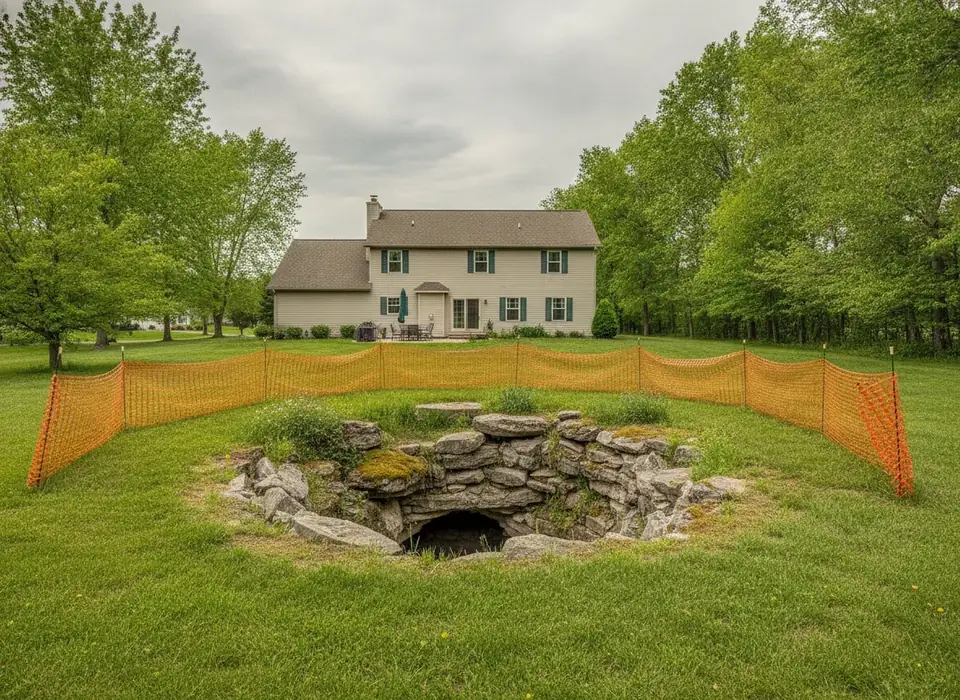
Bowling Green is built on karst. The Kentucky Geological Survey describes the lower part of Warren County as “a slightly rolling, karst (sinkhole) plain characterized by few surface streams and hundreds of sinkholes,” and KGS says more than half of Kentucky sits above karst terrain. Limestone bedrock dissolves into caves and voids, with red clay residuum and loess on top.
A cover-collapse sinkhole forms when soil above a limestone opening is washed or slumps down into it. KGS identifies cover-collapse sinkholes and sinkhole flooding as the karst hazards that cause the most building damage. Signs include a new round depression, a hole after heavy rain, or tilting fence posts or walks.
Most houses near sinkholes are fine. KGS puts it plainly: “Limestone terrain can be subject to subsidence hazards, which usually can be overcome by prior planning and site evaluation.” This page explains who does what, in what order.
Depth to caves varies sharply. City geologist Nick Lawhon has said caves are only 15–20 feet deep in northwest Bowling Green (Russellville Road and Nashville Road) versus about 150 feet north of the river. More in our karst and foundations guide.
Report it first. For a sinkhole on public land, in a street or tied to the city stormwater system, call Bowling Green Public Works Stormwater at 270-393-3628 (stormwater@bgky.org). Keep people and pets back.
City repairs. When the city takes on a sinkhole, reporting describes the method: excavate down to the bedrock “throat,” place geotextile fabric and graded crushed stone, and compact it in layers (Spectrum News). After the April 2025 storms the city expected to repair 11 of the new sinkholes; the rest were on county, private or commercial land.
Homeowner responsibility. Sinkholes on private property that do not involve public drainage are generally the owner's to manage, and damage to the house itself is the owner's to repair.
Near a sinkhole, cracks or sloping floors may come from voids or soft clay well below the footing. The Kentucky Geological Survey notes that structures partly supported on soft residual clay “subside gradually.” That is why we suggest a Kentucky-licensed professional engineer (PE) look at the site before anyone quotes a repair.
In karst, that specification is often deep piers carried to rock.A contractor's free evaluation is a sales estimate, not an engineering opinion
Call 270-393-3628 if public land or drainage is involved.
A Kentucky-licensed professional engineer evaluates the house and ground and specifies the repair.
Companies quote to the engineer's specification.
Depth and load are logged for the engineer to review.
Standard homeowners policies generally exclude earth movement — settling, subsidence and sinkholes — though ensuing damage like fire may be covered; ask your insurer what your policy covers.
Kentucky's Mine Subsidence Insurance Fund (KRS 304.44) is often confused with sinkhole coverage. It covers only “the collapse of underground coal mines,” never karst sinkholes. Warren County's participation is unclear: it joined in 2009 but is missing from the 2024 qualified list, so ask the Kentucky Department of Insurance. See our post on whether insurance covers sinkholes in Kentucky.
| Item | Typical range |
|---|---|
| Structural engineer's report | $300–$2,000; soil report $1,000–$5,000 |
| Steel push pier, installed | $1,000–$3,000 each |
| Helical pier, installed | about $3,500–$4,400 each |
| Underpinning project | $10,000–$40,000 (5–15 piers is common) |
Typical national ranges (Fixr 2026, This Old House 2026, a national installer's published list) — estimates, not quotes.
See the foundation repair cost guide. Ask for the warranty in writing: term, what voids it, whether it transfers to a buyer and any transfer fee.
Kentucky has no statewide general-contractor license (the state licenses trades like electrical, plumbing and HVAC). In Bowling Green and Warren County, the Bowling Green–Warren County Contractors Licensing Board requires any general or specialty contractor to be licensed, on a 12-month license with proof of liability insurance and workers' comp/UI compliance. Homeowners can check a company on the board's Active Contractor Search at bgky.org. Ask for the company's Bowling Green–Warren County contractor license and look it up before signing. Outside Warren County (Glasgow, Franklin, Russellville, Scottsville, Morgantown), licensing is handled locally; ask the city or county building office.
Bowling Green's Building Division (Neighborhood & Community Services) requires a permit to “construct, enlarge, alter, repair or demolish a structure.” Foundation repair isn't named on the page, so ask whether your job needs a permit — structural work usually does; the contractor normally pulls it.
Under Kentucky's home solicitation sales law (KRS 367.410–.460), a buyer can generally cancel a contract signed at home until midnight of the third business day, and the seller must provide a “BUYER'S RIGHT TO CANCEL” notice; there is an emergency-repair exception. This is general information, not legal advice.
It depends on where it is and what it connects to. Bowling Green Public Works handles sinkholes tied to public land and city stormwater; after the April 2025 rains it expected to repair 11 of at least 18 new ones, with the rest on county, private or commercial land. Call Public Works Stormwater at 270-393-3628 to report it and ask.
Call Bowling Green Public Works Stormwater at 270-393-3628 (stormwater@bgky.org, 1011 College St). That is the phone line the city has pointed residents to for new sinkholes. Outside city limits, contact the Warren County or local government office for your area.
Standard homeowners policies generally exclude earth movement, including settling, subsidence and sinkholes, though ensuing damage such as fire may be covered. Coverage varies by policy, so ask your insurer what your policy covers. Kentucky's Mine Subsidence Insurance Fund is separate and covers only the collapse of underground coal mines, not karst sinkholes.
No. Kentucky's Mine Subsidence Insurance Fund (KRS 304.44) covers only the collapse of underground coal mines. Karst sinkholes form in limestone and are not coal mines, so they fall outside it. Warren County's participation is also unclear: it voted to join in 2009 but is missing from the 2024 qualified list. Ask the Kentucky Department of Insurance.
Because the cause may be voids or soft clay well below the footing, and a standard repair might not reach it. A Kentucky-licensed professional engineer can evaluate the site, sometimes with a soil or geotechnical report, and specify the repair, which may mean deeper piers carried to rock. A contractor's free evaluation is a sales estimate, not an engineering opinion.
Tell us what you see at the house and in the yard. We pass your request to independent local foundation companies serving Bowling Green and Warren County, and we usually reply the same day.
Push and helical piers, and how depth to limestone varies.
Sinkhole flooding, drains and sumps after heavy rain.
Engineer, pier and underpinning ranges.
Free, no-pressure quotes from independent companies across Bowling Green, Warren County and South Central Kentucky.