
Structural Engineer or Foundation Company First in Bowling Green?
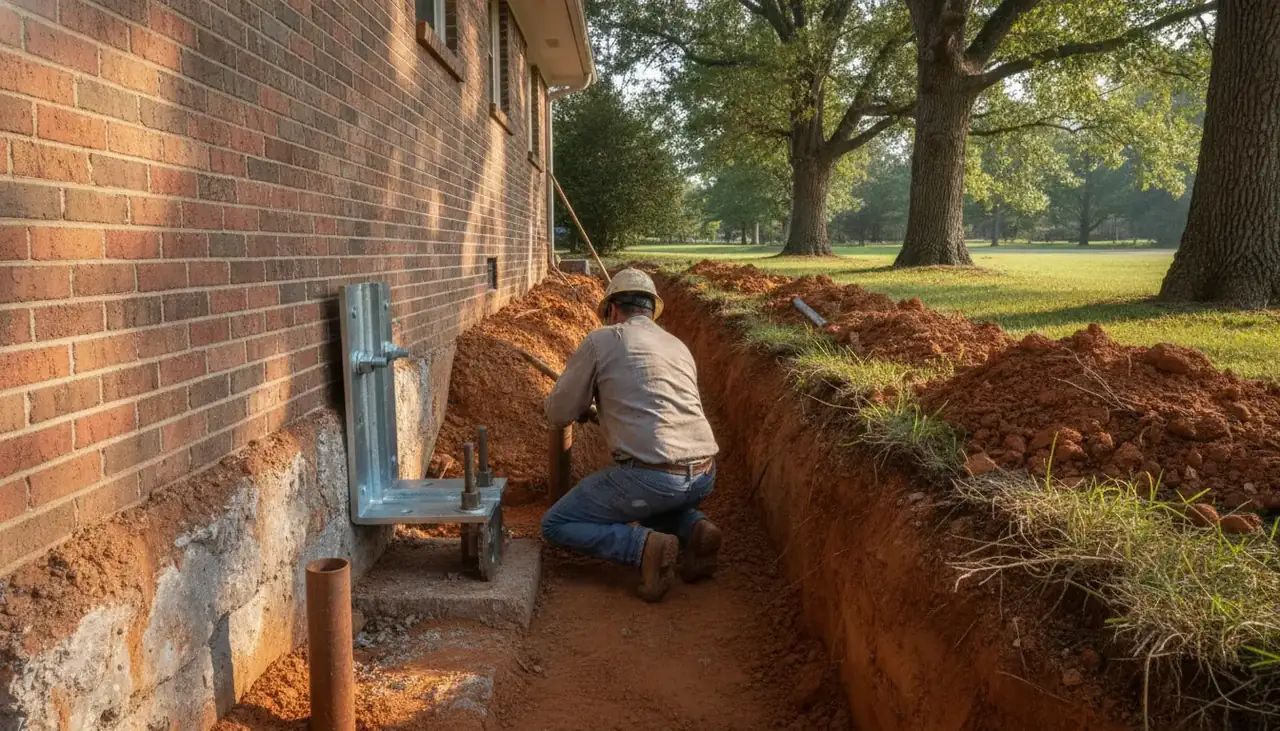
Short answer: if you have one hairline crack or a sunken patio, start with two or three free contractor evaluations. If the ground near the house has dropped, movement is getting worse quickly, contractors disagree on the fix, or you need a document for a sale, hire a Kentucky professional engineer (PE) first and have companies quote to that report. A contractor’s free evaluation is a sales estimate, not an engineering opinion. In Bowling Green, where clay sits on cave-riddled limestone, that difference matters more than in most towns.
Why the order matters on Bowling Green ground
The Kentucky Geological Survey (KGS) describes the lower part of Warren County as “a slightly rolling, karst (sinkhole) plain” with “hundreds of sinkholes.” Common soils here, such as the Pembroke and Crider series, are loess over limestone residuum, the red clay left behind as the rock weathers. KGS notes that structures “partially supported on soft, residual clay soils” can “subside gradually.”
Depth to rock and caves isn’t uniform, either. City geologist Nick Lawhon has said caves sit only 15–20 feet down in parts of northwest Bowling Green near Russellville Road and Nashville Road, versus about 150 feet north of the river. Two houses a few miles apart can need very different repairs, and a quote is only as good as its assumptions about what is under the footing.
KGS puts the upside plainly: limestone subsidence hazards “usually can be overcome by prior planning and site evaluation.” An engineer’s report is one way to do that evaluation before money is committed.
What each one gives you
| Foundation company evaluation | Structural engineer (PE) report | |
|---|---|---|
| Cost | Free | About $300–$2,000; soil report $1,000–$5,000 if needed |
| What you get | A written quote for that company’s repair method | An independent opinion on cause and a repair specification |
| What it is | A sales estimate | An engineering opinion from a Kentucky PE |
Typical national ranges (Fixr 2026, This Old House 2026) — estimates, not quotes.
Neither replaces the other. The engineer usually doesn’t do the repair, and the contractor isn’t giving an engineering opinion. The real question is which one you need first.
When to start with contractor quotes
- Thin vertical cracks in a poured wall that aren’t growing. Our foundation crack repair page explains the usual fixes.
- A sunken sidewalk, patio, driveway or garage slab, where mudjacking or foam leveling is the likely conversation.
- A damp crawl space with no sagging floors.
- Small, slow changes where you mainly want to know the options and a price range.
Get two or three quotes and compare the method, the number of piers or injection points and what’s excluded. If the quotes broadly agree, you may never need an engineer.
When to call an engineer first
- A depression or opening in the yard close to the foundation. After more than 10 inches of rain fell in four days in April 2025, the city responded to at least 18 new sinkholes. See sinkhole and settlement repair for who handles what.
- Movement that is visibly getting worse: cracks widening over weeks, doors that suddenly stop latching.
- Two companies recommend very different repairs, for example one quotes crack injection and another quotes a ring of piers.
- You’re buying or selling and need an independent document. Our guide to selling a house with foundation problems covers that side.
- The house sits near a known sinkhole or a stormwater basin, or in the shallow-cave part of northwest town.
- A home rebuilt or repaired after the December 11, 2021 tornado now shows new cracks or sloping floors.
How a report makes quotes comparable
Without a common scope, three companies can quote three different jobs, and you can’t compare them. With a report in hand, each company prices the same thing: how many piers, where they go and what the engineer wants them to reach. On karst ground, ask every company how it will handle rock that turns out deeper or shallower than expected, and how that changes the price.
The math usually favors the report on pier jobs. Typical national ranges put steel push piers at $1,000–$3,000 each, helical piers at about $3,500–$4,400 each, and full underpinning at $10,000–$40,000, with 5–15 piers common. Next to the cost of a few piers too many or too few, a $300–$2,000 report is small. The piers and house leveling page and the cost guide have more detail.
Older homes around Bowling Green
About 28% of Bowling Green’s housing was built from 1950 to 1979 and 38% since 2000 (ACS 2020–24). Nearby towns skew older: in Glasgow, Franklin and Russellville, most homes were built before 1980. A Kentucky Transportation Cabinet study describes Glasgow as known for “red clay soils and the karst behavior of the underlying bedrock,” and KGS notes Russellville is underlain by karst. An older block foundation that has moved slowly for decades is a good candidate for an engineer’s look before anyone sells you a repair. See the Glasgow and Warren County pages for local detail.
Keep the paperwork together
Whichever route you take, keep the engineer’s report, every quote, the permit, before-and-after elevation readings, pier depths and the written warranty in one folder. Ask whether your job needs a permit; structural work usually does, and the contractor normally pulls it. Ask for the company’s Bowling Green–Warren County contractor license and look it up before signing. Ask for the warranty in writing: term, what voids it, whether it transfers to a buyer and any transfer fee.
Questions homeowners ask
How much does a structural engineer’s report cost?
Typical national ranges put a structural engineer’s report at about $300–$2,000, and a soil report, when the engineer asks for one, at $1,000–$5,000. Those are estimates, not quotes. On a job that may need several piers at $1,000–$4,400 each, the report is a small share of the total and it keeps every company quoting the same scope.
Can a contractor’s quote stand in for an engineer’s report?
Not really. A contractor’s free evaluation is a sales estimate for that company’s own repair method, not an engineering opinion. An engineer’s report comes only from a Kentucky professional engineer (PE). If you need an independent document for a sale, a dispute or a lender, ask a PE rather than relying on a quote.
Will foundation companies quote to an engineer’s report?
Ask each company when you request a quote. Handing every company the same report is the simplest way to compare prices, because each one is pricing the same number and location of piers or anchors. Ask how they will handle rock that turns out deeper or shallower than expected, and whether the engineer will review the final pier records.
We connect Bowling Green-area homeowners with independent local foundation repair, crawl space and waterproofing companies for free, no-obligation quotes. Whether you have a report already or want to see what companies recommend first, request free quotes.